Physics
Chapter 6: Sections 8-10

Web Lecture
Energy Transformation and Conservation
Introduction
When we wish to express by a single word the rate at which wor is done by an agent we shall call it the Power of the agent, defining power as the work done in the unit of time.
The use of the term Energy, in a prcise and scientic sense, to express the quantity of work which a material system can do was introduced by Dr. Young (Lectures on Natural Philosophy, 1807, Lecture VIII).
James Clerk Maxwell, A note on the history of energy (1864)
Outline
Conservation of Energy
We now encounter our first conservation rule: energy is neither created nor destroyed in any physical situation; it can only change form. This rule allows us to compare "before" and "after" situations and determine how the changes took place.
Dissipative Forces
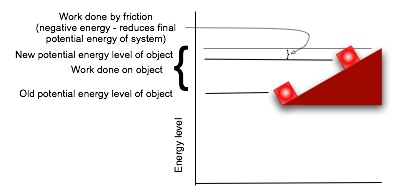
In practice, most conversion processes are not 100% efficient, and some useful energy becomes useless energy. When non-conservative or dissipative forces are at work, the change in potential energy is less than the work done against the field. The difference in energy is lost, converted by friction forces to a form of energy that cannot be recovered to do useful work. This useless energy increases the random motion of the rest of the system, a quantity we call disorder and measure as entropy. Conservative forces do not change entropy, but non-conservative forces increase it. There is no way to decrease the total entropy in an isolated system.
How can we tell if non-conservative forces are at work (so to speak)? Let's assume we want to move a box from point A to point B. If we can move it directly from A to B or indirectly from A to C to B and do the same amount of work both times, all the forces involved are conservative forces. If, however, moving the box from A to C to B takes more work that moving it from A to B, then some force involved is a non-conservative, dissipative force. The final energy state is less than the original energy state by the amount of energy lost to the dissipative force.
Power
We often need to look at work done over a given period of time. (We like rates: rates are any change over time). So we will define a new concept: power is the work done in a given amount of time. P = w/t. But since W = Fd, P = Fd/t. Now d/t is just v, so....
Power = w/t = F * v.
Power is work done per unit time, or force acting at a given velocity. But look: F*v = ma*v, and acceleration means that velocity is changing. So this calculation is only good at an instant in time OR only works if we use calculus to sum the force over some range of change in v. As we have already seen, looking at a situation in terms of dynamics may involve a lot of calculus, because with forces, we need to look at changes every instant. But if we analyze the same situation in terms of energy, we avoid the calculus because energy is a state change; we only care about the initial and final amounts.
Analyzing a situation in both ways (the forces in dynamics and energy states in kinematics) means that we can check our understanding of the situation.
The Concept of Energy
Dimensions and Units
Let's revisit briefly the concept of energy from the view point of its dimensions, the type of units involved.
All matter has certain characteristics: mass, extent in space, charge, temperature, energy state, and duration of existence in a particular form or state. These basic characteristics we express in units of mass, length, charge, temperature, energy, and time. Depending on the unit system we chose, the units have particular values. In the most common system used in science, these are the units of the System Internationale, or SI system: kilograms, meters, coulombs, Celsius or Kelvin degrees, joules, and seconds.
When we consider characteristics without regard to a particular unit system, we say that we are analyzing relationships in terms of their dimensions. Dimensional analysis can often tell us much about an abstract concept like energy, which is a quantity we measure only in terms of other quantities. The base characteristics of matter then can be represented as mass M, measured in units (either kilograms or grams or slugs), duration in time T (days, hours, seconds), extent through space L in one direction, or over an area L*L = L2, or through a volume L*L*L = L3 (cm3, m3, ft3).
It does not matter which units we use as long as we are consistent when we relate characteristics. If we measure using different unit systems, we have to convert one set of measurements to some common set.
Base quantities are quantities we can measure directly, and then express in base dimensions. Mass is a base quantity, expressed in mass units, which in the international system is kilograms, and in the CGS system (centimeter/gram/seconds) is grams. Length or extent in space is a base quantity, expressed in length units (SI = meters, CGS = centimeters). Time is a base quantity, expressed in time units, (SI and CGS systems = seconds). Other base quantities include temperature, and electrical charge.
Density is not a base quantity: it can be derived from an analaysis of mass (M) and volume (length in three dimensions), so its units are M/L3, mass/length3, or in SI units, kg/meters3. Force is not a base quantity; we calculate it by calculating mass times acceleration or work/distance object moved. Acceleration is itself a derived quantity: it is the change in velocity divided by the time over which the change occurs, and velocity is the change in location (displacement) over the time in which that change occurs.
Dimensional analysis helps us understand characteristics of matter that we cannot experience directly. For example, energy is an abstract concept. We don't experience it directly, the way that we experience distance or time. The modern concept of energy dates from the idea of the vis viva, the "living force" of animate creatures, that came from Newtonian analysis of movement.. The realization that energy, work and force are related in the formulae above came from recognition of the similarity of units used to measure each characteristic.
Work, as we have seen, is F d cos θ. The trigonmetric function yields us pure number, because it is itself a ratio of two like objects. Force is measured in newtons, which break down into the units of mass times the units of acceleration, or M * L/T2, which in international system units gives us kg * meters/sec2. Distance is measured in length units, or meters. So work has the units
work = kg * meters2/sec2.
Kinetic energy or energy of motion has the formula mv2/2. In international units, this converts to
KE = kg * (meters/sec)2 = kg * meters2/sec2
Since the units for the two quantities are equivalent, the two must be the same kind of thing: work is simply a form of energy.
If we examine the units of potential energy, we see that they are the same as work and kinetic energy, Since potential energy = mass * acceleration due to the local force field * distance moved in the field, we have
PE = kg * (meters/sec2) * meters = kg * meters2/sec2
So now we recognize that work, kinetic energy, and potential energy must be directly related. We say that work is the amount of energy expended to change the kinetic and/or potential energy state of a particular system.
work = ΔKE - ΔPE
The problem now is to apply these concepts to a particular group of objects. One of the major difficulties in analyzing a particular situation is determine who or what performs work on which objects. The conservation of energy principle requires that a system cannot change its own total energy from inside: that is, it can do no work on itself:
work = 0 = ΔKE - ΔPE so ΔKE = ΔPE
Within the system, we can only convert kinetic energy to potential energy or vice versa.
The total energy of a system is thus its total kinetic energy (energy due to motion) plus total potential energy (the work it could do if it were free to move within a force field). This energy is the mechanical energy of the system:
mechanical energy = KE + PE
The inevitable conclusion of these assumptions and defintions is that for the energy of a given system to change, the system and its environment must interact. Energy must cross the boundary between the system and the environment. One way for this to happen is for the system to do work on the environment, or for the environment to do work on the system.
Solving most energy-force-work situations involves relating the force performing the work (from "the environment") to the work done on the system, represented by a change in the kinetic energy or potential energy of the system. Correct identification of the system and the changes in energy of the system and the environment is necessary to describe any energy event.
We can continue our discussion of units and look at power. Power is the amount of energy expended per unit time to do work. So
P = w/t
If we rewrite this using w = F * d cos θ, we have
P = F * d cos θ / t
We know that d/t is velocity, so another way to write power is
P = F * v cos θ.
Dimensional and unit analyses helps us understand how force, energy, and power are related.
Practice with the Concepts
Discussion Points
Companion website [6th edition]
You may find further discussion of the applications of these concepts helpful. The sixth edition of our text has a freely-available companion website. Click on Chapter 6 in the "Select Chapter" bar at the top of the home page, then select "Applications". The Applications 1 link discussies the history of the idea of "energy"; Applications 2 discusses friction in more detail. Some of the links originally cited by these pages are now, unfortunately, no longer available.
- How does the concept of energy change over time?
- Can energy be directly observed?
© 2005 - 2026 This course is offered through Scholars Online, a non-profit organization supporting classical Christian education through online courses. Permission to copy course content (lessons and labs) for personal study is granted to students currently or formerly enrolled in the course through Scholars Online. Reproduction for any other purpose, without the express written consent of the author, is prohibited.