Physics
Chapter 7: 5-10

Web Lecture
Collisions
Introduction
God in his omnipotence has created matter together with the motion and the rest of its parts, and with his day to day interference, he keeps as much motion and rest in the Universe now as he put there when he created [it].
- Rene Descarte, Principles (1644)
We've already talked about how energy (PE and KE) is conserved in an isolated system. Now we look at how momentum (mv) is conserved. Both laws of conservation are an outgrowth of Newton's laws of motion, in particular, the law of inertia, which requires an outside force acting on a system before the velocity of the system can change or undergo acceleration. If mass is constant and velocity cannot change, then the two quantities that depend on mass and velocity must remain constant. While we can transfer energy and momentum among components of a system (whether rigidly connected or moving independently within the system boundaries), the total energy and total momentum cannot change unless we exert force on it.
Outline
Collision Kinematics and Conservation of Momentum
Collisions in One Dimension

We need to consider two kinds of collisions (in whatever dimensions we use). The first is the elastic collision. In this system, both objects remain independent; no energy is expended in "sticking" the two objects together. Examples of elastic collisions include billiard balls on a table, or the baseball and bat in a home run. Both of these situations are optimized to reduce the amount of energy lost during the collision to noise, heat, and deformation of the objects. In particular, the ball recovers its shape, so that most of the energy transfered from the bat, or redirected by the bat, goes into the flight of the ball.

In inelastic collisions, the objects stick together and move as a unit after the collision. We have to account for the momentum of the final "object" as p = (m1 + m2) * v.
One thing to realize is that we have to preserve momentum from moment to moment. Consider the elastic collision from the point at which the objects are together, until they reach their final separation (or we stop tracking them). The momentum at the instant of contact and the momentum of the scattering objects must be the same. The objects are not leaving the system! They are redefining the spatial boundaries of the system.
This has implications for explosions and rockets that accelerate by exhausting gases. The initial object is at rest. The final set of objects, taken as a whole, is also at rest, that is, the center of mass of the sum of objects remains motionless, even though there is no longer anything physically there, and the mass is now lots of bits wildly careening away from each other toward the far ends of the universe. This means that if a rocket throws gases out one end, the rocket itself must move forward in order to conserve momentum. Rockets don't shoot up in the air because their exhausing gases are "pushing" on the ground or the atmosphere. They go forward in one direction because we've thrown something out the back in the opposite direction.
Finding and keeping track of the center of mass becomes an important part of collision analysis.
Center of Mass and Collisions in One Dimension
Centers of mass
We have only considered forces applied to centers of mass so far. Any force applied to a center of mass (or along a line that passes through the center of mass) will move the object from its current position. This is translational motion.
Any off-center force will cause an object to rotate around an axis, rather then move it from its point of origin.. This is rotational motion, and should not be confusion with the motion of an object in a circle, or revolution (which may occur with or without rotational motion).
Try this out!
- Find the center of mass of a pencil by balancing it on your finger.
- Mark that point.
- Now put the pencil on a smooth surface.
- Push the pencil at the center of mass point--the whole pencil moves across the table with translational motion.
- Push the pencil at any other point--it will tend to rotate around the center of mass which will not move.
Because of this tendency, the center of mass is an important point in any physical object. An object suspended from its center of mass will be balanced and not pivot. An object with most of its mass above its center of mass (relative to earth's gravitational field) will fall over unless the mass is balanced precisely above that center.
If we suspend an object from any other point (not at the center of mass), the body will rotate, if at all possible, until the center of mass is directly below the suspension point. The practical effect of the phenomenon means that we can use plumb bobs, for example, to determine the vertical direction in building.
If we have an extendend object or set of objects, then the distance to the center of mass of the group along a coordinate axis is the sum of the centers of mass distances along that axis. This can be determined by using the formula:
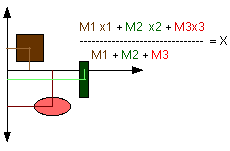
and adding terms for each mass involved [here we used only 2]. Note that the mass units cancel (although the mass magnitudes contribute to the final position) so that the result is in the appropriate distance units.
For an irregular shape, we need calculus to sum up all the masses and determine the appropriate location of the center of mass. Note that for some bodies, the center of mass may lie outside the physical body. A force on such a body must still lie on a vector through this point in order to move the body with translational motion rather than merely rotating it--and any such force must come from outside the body itself.
You should compare simulations of elastic and inelastic collisions, varying speeds and mass. How does changing the elasticity of the collision change the outcome of the collision?
Collisions in two dimensions
While we concentrate in this chapter on collisions in one dimension, it is important to remember that momentum and energy are conserved in collisions in multiple dimensions as well.
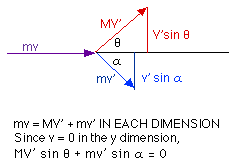
The same thing applies for MV'cos θ + mv cos α = 0.
In working 2 and 3 dimensional collision problems, it is necessary to chose a frame of reference that will simplify the mathematics involved. Usually, the initial velocity of one of the objects is used as the x or y axis, and the initial and final velocities are then calculated on this frame. Except for the additional trigonometry and calculations required for handling each vector component in multiple dimensions, there are no additional physical considerations.
Practice with the Concepts
Discussion Points
- How can a rocket change direction when it is far out in space and essentially in a vacuum?
- Judy and Elizabeth decide to play tug-of-war on a frictionless (icy) surface. Judy is considerably stronger than Elizabeth, but Elizabeth weighs 160 lb whereas Judy weighs 145 lb. Who loses by crossing over the midline first?
© 2005 - 2026 This course is offered through Scholars Online, a non-profit organization supporting classical Christian education through online courses. Permission to copy course content (lessons and labs) for personal study is granted to students currently or formerly enrolled in the course through Scholars Online. Reproduction for any other purpose, without the express written consent of the author, is prohibited.