
Physics
Chapter 8: 4-6

Web Lecture
Rotational Dynamics and Torque
Introduction
Definition 3
The centre of mass or the centre of inertia is a point in any body, around which
the mass or inertia is equally distributed in some manner according to the equality of
the moments.
Explanation
The centre of mass or inertia is the same point, as that which is commonly called
the centre of gravity; moreover since this point thus is essential to all bodies, in order
that for these bodies it can be agreed upon on account of inertia alone, and moreover
gravity must be considered as an extrinsic force acting on bodies, thus I have preferred
to attribute to that the name of the centre of mass or inertia, since that is understood to
be determined by inertia only.
Leonhard Euler, Theoria Motus corporum Solidorum Sue Rigidorum Vol 1. Chapter 1
Outline
Rotational Dynamics: Forces on Rotating Rigid Bodies
Frames of Reference Revisited
We've established the ground rules for analyzing rotational motion, or rotational kinematics. Now we are ready for the consideration of rotational dynamics — that is, of the forces which cause things to rotate. Remember Newton's fundamental rule: without a force, nothing changes its state of motion. This is as true of rotational motion as it is of linear motion.
There are some differences, however. In our analysis of linear forces, we restricted ourselves to forces with constant acceleration (this is supposed to be an introductory, non-calculus course!). One of the results of relativity theory requires that the laws of physics apply to a situation regardless of which frame of reference you use, as long as the frame of reference itself is not accelerating. In our work with linear forces, we generally chose a frame of reference attached to the ground or some convenient point in space, while the object itself underwent acceleration due to gravity or some other force.
When considering rotational motion, we have to remember that even when a point is moving with uniform speed around the circular path of its rotation, it still has radial acceleration. A frame of reference attached to a rotating object will make some things appear to be operating under a force even though they are not -- because our frame of reference is accelerating. The acceleration we observe in bodies outside this frame is the result of our own motion.
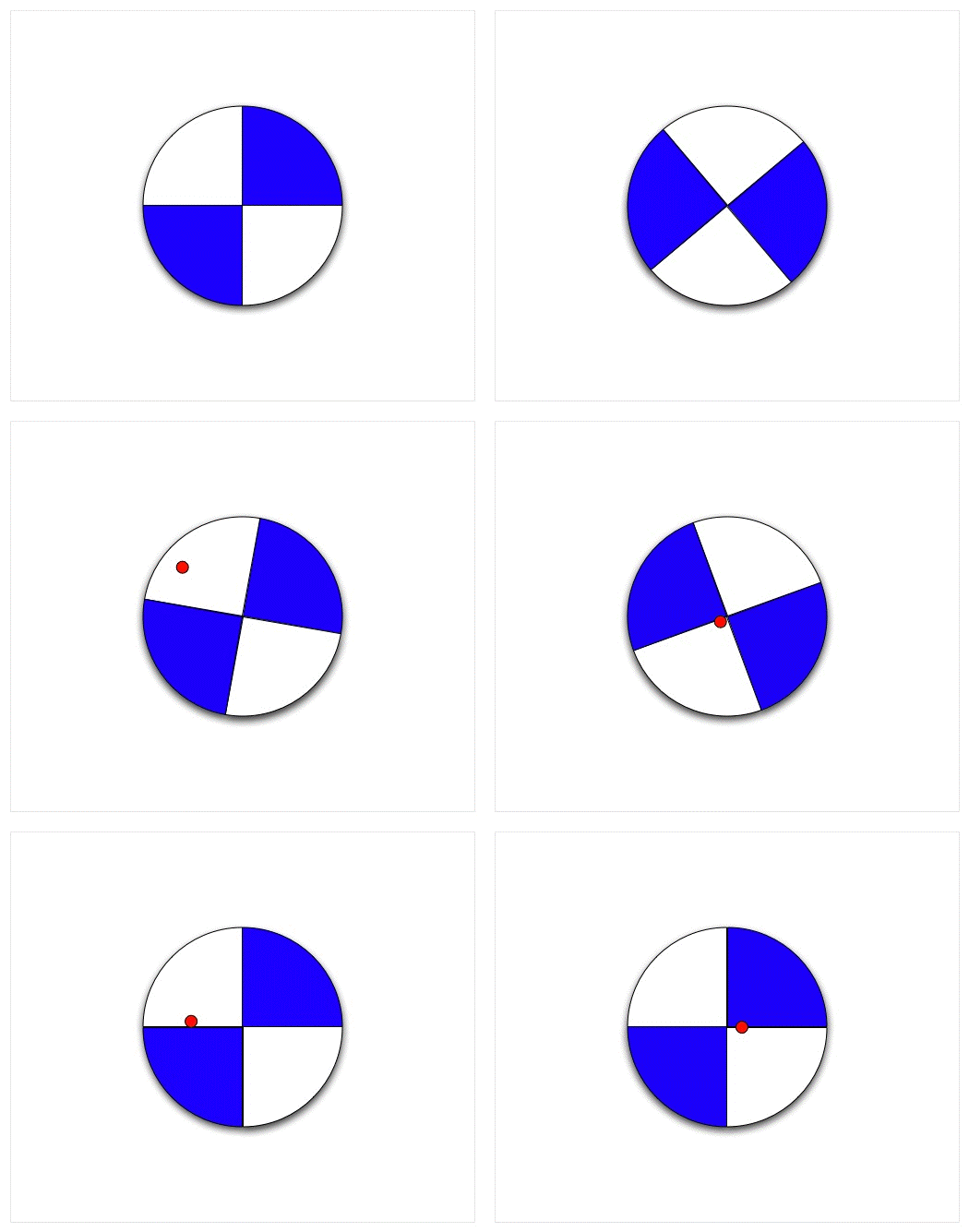
|
The animation goes through three cycles: |
Rotational Dynamics: Off-Center Forces
Objects rotate when a force acts against a point that is not the center of mass. Until now, we've discussed forces acting on bodies as though the force went through the center of mass, resulting in translational motion — the movement of the center of mass or center of gravity through space. With rotational motion, the center of mass remains fixed, while points on the object move relative to this point. We describe a line through this point, and normal to the plane of rotation, as the axis of rotation, a concept we'll need in a moment. To the characteristics of the force that we've already seen in linear motion (the magnitude and linear direction of the force), we add one more: the distance of the force vector from the axis of rotation.
|
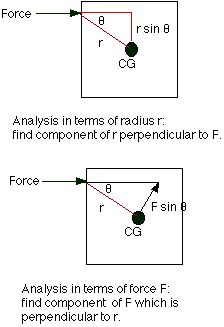
If we go back to our flat-sided pencil diagram, we can now look at the force components which are co-operating to produce the rotation. The force F acts through the radial distance and at right angles to it. We can analyze the right-angle component of r with respect to F (top diagram), so that we multiply F * r sin θ, or we can use the right-angle component of F with respect to r (bottom diagram), so that we have F sin θ* r. Either way, we wind up with torque, or rotational force τ, defined as the vector cross product of F and r: τ = F X r = F r sin θ. |
We have already discussed the addition (and subtraction) of vectors at some length in chapters 2 and 3, and we introduced the other "multiplication" operation for vectors, the scalar DOT product, when we discussed work. Here's the difference:
| DOT | F • r | F r cos θ(scalar) |
| CROSS | F X r | F r sin θ(vector) |
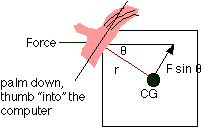
Since the cross product is a vector, it has to have a direction. By convention, the direction of a torque follows the right-hand rule, which says that if you point the fingers of your right hand in the direction of the force F component perpendicular to the radial line from the axis, so that your palm would push in the direction of r (toward the axis of rotation), then your thumb, at right angles to your fingers and in the same plane as the palm, will point in the direction of the torque. In our diagram above, your fingers would point off to the "2 o'clock" position, your palm would "push" down toward the CG dot, and your thumb would point into the computer (or paper, if you are reading this as a printout). We always draw the force and radius so that they lie in the same plane; the direction of the torque is always out of this plane.
If you are still having trouble visualizing this, consider how you turn a doorknob on the right side of a door with your right hand. Imagine yourself standing with your fingers curled around the knob, and your palm pushing on the knob toward its center. Your right thumb will be pointing toward the door. If you "push" on the know, you turn the knob counterclockwise so that your fingers move forward away from the position of your palm, the knob moves inward in the direction your thumb points — into the door. If you "pull" on the knob, it rotates clockwise and moves outward from the door. The torque you exert causes the knob to move in a direction that is at right angles to the plane containing the torque.
Practice with the Concepts
Discussion Points
- If the net force on a system is zero, is the net torque also zero?
- If the net torque on a system is zero, is the net force also zero?
- Two inclines have the same height but make different angles with the horizontal. The same steel ball rolls without slipping down each incline. On which incline will the speed of the ball at the bottom of the greater?
© 2005 - 2026 This course is offered through Scholars Online, a non-profit organization supporting classical Christian education through online courses. Permission to copy course content (lessons and labs) for personal study is granted to students currently or formerly enrolled in the course through Scholars Online. Reproduction for any other purpose, without the express written consent of the author, is prohibited.