Physics
Chapter 13: 1-5

Web Lecture
Thermal Equilibrium and Gas Behavior
Introduction
The three laws of thermodynamics:
You can't win.
You can't break even.
You can't quit the game.
— Joke popular among physics graduate students.
Outline
Thermal Equilibrium
We started with kinematics and dynamics where we ignored the composition of bodies, using only their total masses to "whole body" movements through space and time. Then we took a look at situations where molecules were free to move in limited ways, in liquids, or in oscillating motions with limited amplitudes. We turn now to situations where molecules are free to move and interact: in gases.
Pressure, Volume, and Temperature
[From a chemistry point of view....mostly. This doesn't exactly follow the chapter sequence, so don't panic. ]
First model: think about gases as collections of very small, very energetic billiard balls. They are constantly in motion. If you heat them up, they move more quickly. They bang against the sides of their container, and if the container has an opening, they fly out. If you mix two different gases, they will operate independently of each other, but combine their total effect on the universe of their container.
The three physical characteristics of a gas are volume, amount (measured usually in number of particles or mass), and temperature. These characteristics are interrelated. If you change one, the others will change to compensate. Keep in mind:
- Volume is measured in cubic length units or in volume units. One liter = 103cm3.
- The number of molecules involved can be determined from the number of moles involved, which in turn is related to the mass of the gas involved. A mole is 6.03 * 10 23 particles, either atoms or molecules. If you know the mass and composition (in atoms) of your gas particles, you can calculate the number of molecules (and moles) involved.
- The temperature is usually expressed as an absolute: in Kelvin. (Note that it is 5 Kelvin, but 5 degrees centigrade, 5 degrees fahrenheit). The conversion formula is TK = TC + 273.15. In other words, the size of the degree in Centigrade (or Celsius) is the same as a unit on the Kelvin scale, but the point of origin of the scale is offset by 273.15 units. Watch the significant figures in any problem to determine whether you need to take the .15 fraction into account.
Pressure is the force exerted by the gas particles on the sides of its container. It is in units of force/area, so pounds/square foot is a legitimate pressure. Normally we use the SI scale: one newton/on square meter is called a Pascal, after the French philosopher. We also use atmospheres, which is roughly 14.7 pounds/square inch (that's the weight of about 8 miles of Earth's atmosphere at sea level). You may be more familiar with barometric pressure, in which 1 atmosphere is 760 mm (about 29.92 inches) from weather reports. The weather reporter announces barometric pressure in inches, usually around 30. Falling barometric pressure indicates a low pressure region of air is moving in (usually a storm), rising barometric pressure usually indicates good weather. Some people can feel the change in pressure and sense that rain is coming.
Given a pressure in pascal, you can convert it to atmospheres by the relation 1 atm = 1.01325 * 105 pascal and to millimeters of mercury by the relationship 1 atm = 760 mm Hg. Of course, you can invert the formulas as needed to get pascal or mm Hg from atmospheres, and even to get mm Hg from pascal:
1 pascal = 1/1.01325 atm = .9869 atm
1 mm Hg = 1/760 atm = .001316 atm
The Ideal Gas Law
The ideal gas law relates pressure, number of gas particles and temperature to each other. It is one of those relationships that took a long time to work out, partly because there are so many factors involved. Robert Boyle showed that the pressure of a gas is inversely related to volume, at a constant temperature and amount of gas. Jacques Charles was able to show that volume of a gas is directly proportional to temperature, and moreover, that the volume of a gas would be zero at zero Kelvin. Joseph Guy-Lussac showed that if volume was a direct function of the number of molecules, then equal volumes of different gases all contained the same number of molecules. This paved the way for Avogadro to suggest that gases at the same temperature and pressure contained the same number of molecules (the 1811 suggestion was not widely accepted until 1860).
If we break the ideal gas law down into pieces, and assume that our molecules are perfect billiard balls, though, each piece makes sense.
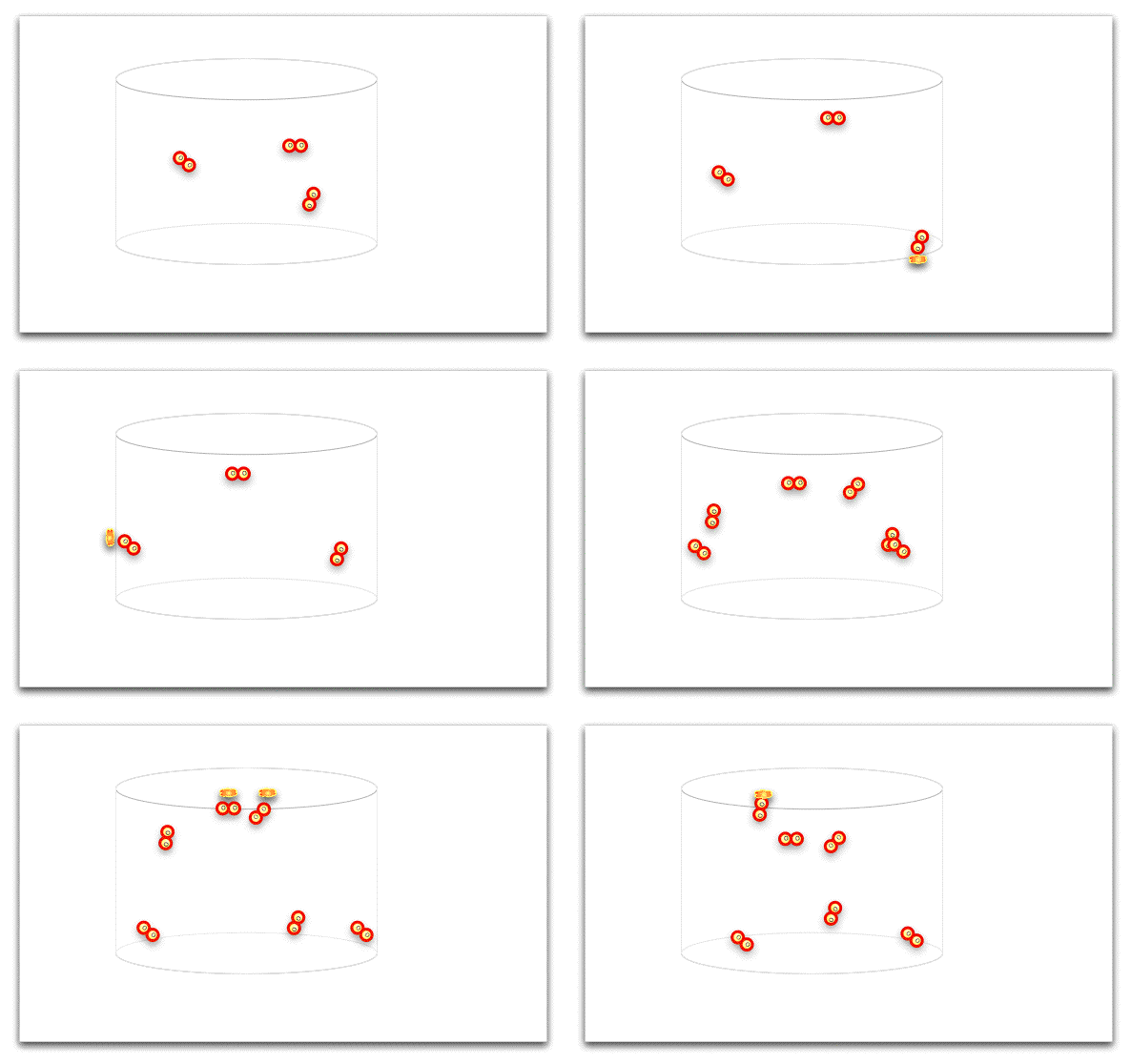
Doubling the number of molecules increases the number of collisions with the side of the container.
Consider volume and temperature, and a situation where we want to hold pressure constant. We don't want the number of hits of gas molecules against the side of the container to change, and we measure them in hits/second /area, or force/area. If we increase the number of molecules in the container, we have more molecules hitting the sides of the container. In order to make the number of hits/area in a single unit of time remain constant, we have to increase the surface area of the container. Since surface area of a container of fixed shape (but obviously not size) is related to volume, increasing the volume of the container increases the surface area. We can write volume = some constant * number of molecules involved. Increasing the number of molecules directly affects the volume. The constant remains the same (remember we are holding pressure constant) regardless of the changes to volume or number of molecules: V = k * n, where V is volume, k is a constant including pressure in this case, and n is the number of molecules.
By the same reasoning, volume is directly proportional to temperature. If we increase the temperature, the molecules speed up, hitting the sides of the container more often. Increasing the temperature directly increases the volume: V = k * P. This time, k includes a constant absolute temperature.
Now suppose that we want to increase the pressure. To do that we either need to increase the number of molecules (more hits per unit area, because we have more to do the hitting) or increase the temperature (more hits per unit time, because what we have travels faster). Both these options assume we are holding the volume of the container and the other factor constant. That is, we change number of molecules, but not temperature and volume. We can also change pressure by decreasing the size of the container. This means there is less surface area (more hits per unit area) and the molecules don't have to travel as far between collisions with the surface area (more hits per unit time). This is an inverse relationship: as volume decreases, pressure increases: V = k/P, where k includes a constant number of molecules and temperature.
Eventually, all the pieces were put together in one astounding, simple, elegant equation:
Scientists save the term "elegant" for those really wonderful formulas that describe complex situations with some (relatively) simple set of relationships. The ideal gas law is elegant.
Gas Law Applications
Given this relationship, we can come up with a value for R, the equation constant. First of all, let's consider what happens at STP, that is, Standard Temperature (= 0.0 degrees Centigrade) and Pressure (1.00 atmosphere). A mole of any gas occupies about 22.4 liters (determined by many experiments) at STP. Putting all this into the equation for ideal gases and solving for R gives
We can use the constant now in the ideal gas law, regardless of the type of gas, pressure, temperature, or volume ranges involved.
Now we can do some calculations. We can set up ratios between two different states of a gas.
Suppose we change volumes, while holding temperature and number of molecules constant. In the first case,
In the second case,
Since both P1V1 and P2V2 are equal to nRT, they are equal to each other:
Solving for pressure on one side and volume on the other gives
Knowing any three of the values will allow us to calculate the fourth. For example, what happens to the pressure in a can of gas when 75% of the gas escapes if we assume a starting pressure of 255 lbs/square inch?
First, solve for the relationship:
Factoring for the constant parts gives
We want the final pressure P2, so we solve for that:
Note that we don't need the absolute number of molecules, only the ratio:
We can finally calculate the actual pressure:
Because we lost so much gas out of the can, only 1/4 of the original pressure is exerted by the remaining gas.
Practice with the Concepts
Discussion Points
- Why will a glass container break apart if one part of it is heated or cooled more rapidly than adjacent parts?
- Can you determine the temperature of a vacuum?
© 2005 - 2026 This course is offered through Scholars Online, a non-profit organization supporting classical Christian education through online courses. Permission to copy course content (lessons and labs) for personal study is granted to students currently or formerly enrolled in the course through Scholars Online. Reproduction for any other purpose, without the express written consent of the author, is prohibited.