Biology
Chapter 10: Molecular Biology of the Gene

Lecture
Discovering DNA Structure
Web Lecture
DNA Structure
Genes carry the information required for the cell to manufacture proteins, from which everything (membranes, Golgi bodies, starch molecules, proteins) in the cell is built. During the mid-20th century, the main goal of genetics was to determine the structure of genetic material. [Dates are the date of publication of the theory or experimental results.]
The experimental evidence
| Scientist | Study or Experiment | Significance |
| Friedrich Meischer 1869 |
Meischer attempted to isolate protein components of leukocytes, and discovered a new substance in the nucleus, which he named nuclein. | Showed that nucleic component was unique within cell; later renamed as "deoxyribonucleic acid" to reflect chemical composition. |
| Archibald Garrod 1902 |
Studies of human alkaptonuria cases, documented in Inborne Errors of Metabolism | Showed that an enzyme failed to oxidize homogentisic acid; occurrence patterns followed pattern of single trait inheritance. Concluded that one gene governed formation of enzyme. |
| Frederick Griffith 1928 |
Griffith's experiment bred a strain of bacteria which was normally fatal to its hosts (mice). He killed the virulent bacteria off, and added normally benign bacteria to a nutrient mix containing the dead bacteria. Mice injected with the mix died. | DNA matter can be transferred from one organism to another, and used by the second organism. In this case, the benign bacteria begin to act like the virulent bacteria, and produce substances that are poisonous to the host. |
| George Beadle and Edward Tatum 1941 |
Studied mutations of bread mold (neurospora) to identify point at which metabolic pathway disrupted. | In a bread mold, nutrients are broken down into ornithine, and then into citrullin, and finally to the amino acid arginine, which the mold needs to build proteins for metabolic functions. Some mutations of the bread molds could grown on a nutrient base with only onrithine, some with ornithine and citrine, but some mutations could grow only on nutrients that supplied the arginine itself. This led Beadle and Tatum to conclude that the breakdown step between ornithine and citrulline required a different enzyme than the one for the reaction that broke down citrulline to arginine. In other words, each genetic defect controlled a different enzyme. |
| Erwin Chargaff 1950 |
He investigated differences in DNA among species. | All DNA, regardless of species, has similar amounts of thymine and adenine, and similar amounts of guanine and cytosine, leading hime to assume that A attaches to T, and G to C. |
| Alfred Hershey and Martha Chase 1952 |
Viruses inject two substances, DNA and proteins, into bacteria, which then begin to reproduce the viruses. Hershey and Chase created viruses with radioactive sulfur-bearing proteins, and radioactive phosphorous-bearing DNA, then allowed the viruses to attack their bacteria colonies. When the bacteria were placed in a centrifuge and separated from their virus-laden nutrient medium, Hershey and Chase found that the bacteria contained radioactive phosphorus in the DNA, but not sulfur in their proteins. | The viruses used DNA to pass genetic information to the bacteria, not proteins. DNA is genetic information carrier. |
| Rosalind Franklin and Murray Wilkins 1953 |
Used X-ray crystallography to map locations of nucleotides in DNA crystals | Verified a ladder-like structure with phosphate and ribose molecules on the "runners" and the nucleotides as rungs. |
| James Watson and Francis Crick 1953 |
Using Franklin's data, Watson and Crick built models to scale. | Determined the only fit for the data was a double helix. |
Too simple to be true
The experimenters whose work led to a model for the structure and purpose of DNA had to fight an uphill battle against the prevailing assumption that DNA was too simple a molecule to account for all the information required to "program" a single-celled organism, much less a complex organism like a fish, or a human being. DNA is made up of a chain of nucleotides, each one consisting of a phosphate, a ribose (5-carbon sugar), and a base molecule (so called because it is basic, rather than acidic). The phosphates and the riboses are the same in every DNA nucleotide, but the bases can differ.

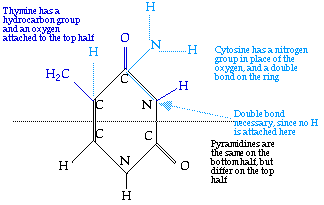
However, there are only four bases in DNA: two pyrimidines (thymine and cytosine) and two purines (adenine and guanine). Note that the pyrimidines have one ring, made of 4 carbons and 2 nitrogens. Half of the ring is the same in both thymine and cytosine; the other half differs in the number of double bonds and the attached atoms or sub-molecular groups.
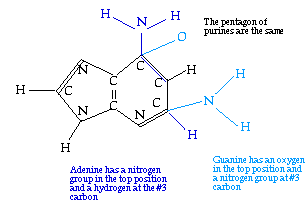
Purines have two rings, and pentagon and a hexagon. The pentagon is the same in both adenine and guanine, but the hexagon differs between the two bases in the attached molecules and the number of double bonds.
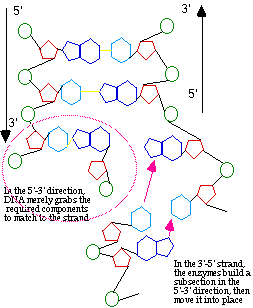
One of the more difficult concepts to understand is the directional nature of the two strands of the DNA helix. Look carefully at the digram below:

Remember that in a sugar (sug as ribose, above), the carbons of the ring (which forms whenever the ribose is in water) are numbered for identification. One of the carbons is "off" of the ring; it is always the last or highest numbered. It is usually attached to a carbon next to the oxygen in the ring; the carbon on the far side of the oxygen becomes the number one carbon. With this scheme in mind then, we can look at how the other groups are attached to the ribose molecule. The phosphate in the nucleotide is attached to the number 5 carbon. The phosphate on the next nucleotide in the change is linked to the number 3 carbon of the current nucleotide's ribose. That phosphate is attached to the #5 carbon of its own ribose molecule. We can use the carbon numbers to specify the direction we are moving n the chan: down the #3 links , or up the #5 links (where up and down are purely arbitrary ways of expressing direction).
Here's how all the pieces come together (you may need to refresh to see the animation).

Replication Processes
When DNA replicates, the strand breaks apart, like a zipper becoming unzipped--you can think of the DNA helicase and helix-destabilizing proteins as the zipper, and each strand of DNA as one side of the zipper; each nucleotide would be a tooth.
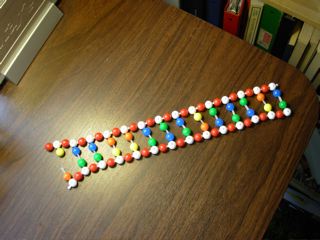
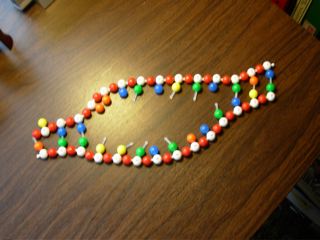
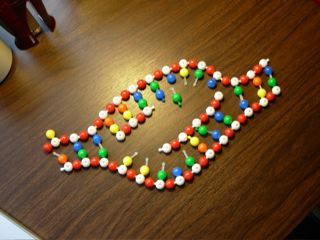
Red beads = Phosphate, white beads = riboses, green = thymine, blue = adenine, orange = guanine, yellow = cytosine.
For the duplication process, you have to forget the zipper analogy. Replication occurs along the strand in the 5'--->3' direction. Since this is the normal order of one side of the DNA chain, that side simply matches each adenine molecule to a thymine, each T to an A, each guanine to a cytosine and each C to an A, and adds the appropriate phosphates and riboses from the supply in the cell (remember those sugar molecules we made during photosynthesis and aerobic respiration? It is time to use them!) to make the outer strand.
But the 3'-5' strand also has to be built in the 5'-->3' direction. Enzymes "examine" the original 3'-5' strand, then assemble sections in the 5'-3' direction which they attaches to the original 3'-5' strand.
During normal cell functions (not reproduction, in other words), the DNA is wrapped around clumps of proteins (called histones), like a knotted string. The histones contribute to the 60% of the chromatin that is protein, and keep the chromatin/DNA components organized.
Some more stuff on RNA
In gene expression, the information encoded in the DNA sequence is used to make proteins required by the cell for growth, organelle production, cell replication, and other metabolic functions. In eukaryotic cells, the DNA never leaves the nucleolus within the nucleus, except during cell replication. A second type of nucleic acid, RNA, is used to carry the information out of the nucleus and into the cell. While there is no nuclear membrane separating DNA from the rest of the cell in prokaryotic (bacteria) cells, these cells also use RNA to translate DNA information into a form from which the bacteria can create the proteins necessary to carry out its metabolic functions.
RNA, or ribose nucleic acid, is much like single strand DNA: it is a chain of nucleotides containing a phosphate, a pentose sugar, and a nitrogenous base. It differs structurally from DNA in two important ways:
- The pentose sugar is ribose and has an extra oxygen
- Uracil, a pyrimidine, occurs in place of thymine
Gene information
Before we go into how RNA can be used to make proteins, we need to review what proteins are. Recall from chapter three that proteins are long, specially coiled up chains of amino acids held together by peptide bonds. While there are thousands of different proteins complexes, they are all assembled from 20 common and a few (the number varies depending on the species) uncommon amino acids.
One of the most important discoveries in genetics in the last 40 years was the realization that only a very short sequence of RNA nucleotides--three, to be exact--was required to specify each of the amino acids for reproduction. In the 1960s, each amino acid was matched to its own codon, or 3-nucleotide sequence. Some amino acids are designated by more than one sequence, but each sequence is responsible for only one amino acid, or for signalling the end of a particular protein sequence. Once the geneticist has determined a given sequence, he knows the amino acid that will be produced by the RNA containing that sequence.
| First position | Second position | U in 3rd | C in 3rd | A in 3rd | G in 3rd |
| U | U | Phenylalanine | Phenylalanine | Leucine | Leucine |
| C | Serine | Serine | Serine | Serine | |
| A | Tyrosine | Tyrosine | STOP | STOP | |
| G | Cysteine | Cysteine | STOP | Tryptophan | |
| C | U | Leucine | Leucine | Leucine | Leucine |
| C | Proline | Proline | Proline | Proline | |
| A | Histidine | Histidine | Glutamine | Glutamine | |
| G | Arginine | Arginine | Arginine | Arginine | |
| A | U | Isoleucine | Isoleucine | Isoleucine | START/Methionine |
| C | Threonine | Threonine | Threonine | Threonine | |
| A | Asparagine | Asparagine | Lysine | Lysine | |
| G | Serine | Serine | Arginine | Arginine | |
| G | U | Valine | Valine | Valine | Valine |
| C | Alanine | Alanine | Alanine | Alanine | |
| A | Aspartic acid | Aspartic acid | Glutamine | Glutamine | |
| G | Glycine | Glycine | Glycine | Glycine |
© 2005 - 2026 This course is offered through Scholars Online, a non-profit organization supporting classical Christian education through online courses. Permission to copy course content (lessons and labs) for personal study is granted to students currently or formerly enrolled in the course through Scholars Online. Reproduction for any other purpose, without the express written consent of the author, is prohibited.