Natural Science - Year I
Unit 0: Welcome to Natural Science Year One

History Weblecture for Unit 0
| This Unit's | Homework Page | History Lecture | Science Lecture | Lab | Parents' Notes |
For 2026: Please note that units are considered "under revision" until two weeks before the class date, and page content, web assignments, and exercises may change before that deadline.
History Lecture for Unit 0: Preparing for Chat Discussions
For Class
This section gives you a framework for the unit. It tells you the historical period, geographic locations, people, and scientific theories covered in the unit materials.
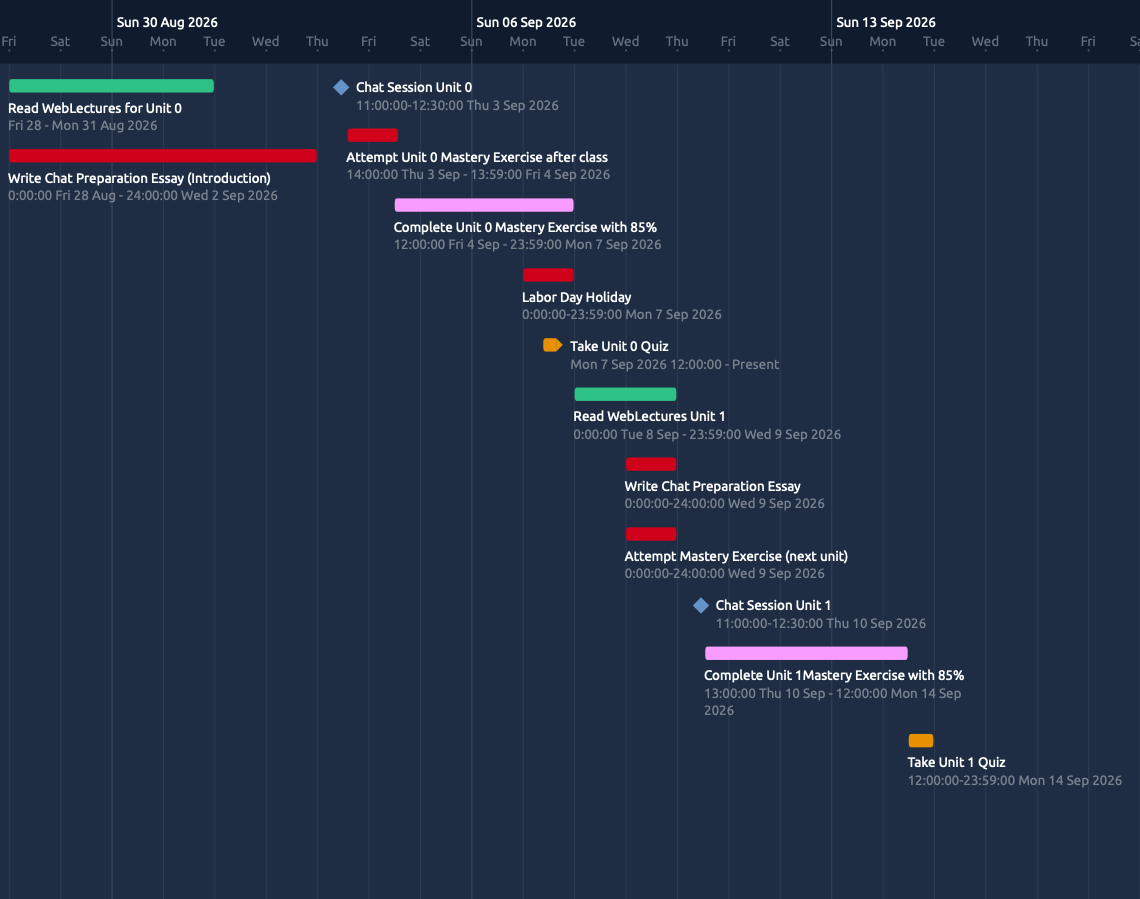
- Period: [The centuries or dates covered by the unit.] Each unit will normally have its own timeline. For this Unit, however, we have a chart laying out the weekly rhythm of this course. To see a history weblecture timeline, click on the timeline icon.
 . In some weblectures, the timeline may display within the weblecture and allow you to navigate and review detailed information.
- Geographic Location: The whole world! This line will list countries and may link to maps you should review if you are not familiar with locations or place names.
- People to know: This line will list the people or groups of people covered in the unit. For our first meeting, these people are the other members of your class!
- See science topics: Normally, this briefly outlines the corresponding scientific theories covered in the unit. But for now, we focus on methods of surviving the course, so this unit's science lecture covers Doing the Written Assignments for Natural Science.
Outline/Summary
- Reading for Meaning
- Hints on how to study history
- Study Styles
- Getting the Most out of Chat
- Study/Discussion Questions
- Further Study
Reading for Meaning
Most history lectures will have web assignments — reading that you must do on another webpage or site. They will be in a box like the one below. They usually contain questions about the reading to help you identify what is important.
Read the following sections from Student Study Guide for this course. You may need to follow embedded links in the reading to find answers for the questions below.
- Why Study Science?
- The Science Course Online
- Managing your Time
- Weblectures
- Getting to Know the Textbook
- What is a physical law?
- What kind of math background do you need to have for this course?
- Where can you find a list of all the parts of a normal Natural Science unit?
- When do you read the web lectures?
- What is the textbook for this course?
Hints on How to study the history sections of this course
Because there is a lot of material in this course, you will want to develop study habits that help you learn the material. Studying anything requires certain skills, but there are also certain techniques you can develop to study specific subjects, like history and science.
Study Styles
Different people have different study styles. Some find it easy to read and remember written information. Some are better at remembering what they hear, still others are better at remembering things they have done "in real time", whether it is information they have written down, drawings they have made, or an experiment they have performed. You should try to do as many different kinds of learning activities as you can, and if you are short of time, focus on those that are required and those that help you the most.
As you read, take notes about the things you think you should remember:
- What facts do you learn about people or events (dates, locations, family background, education, accomplishments, influence).
- What significance do the people or events have (new ideas presented, influence on others, changes to political structures, economy, technology).
- What doesn't make sense or puzzles you? What don't you understand? (terms, concepts, how one thing causes or influences another)? Write down your questions. Bring them to chat. Ask them! One of the hardest things to learn as a student is how to figure out what you don't know. You may think asking a question makes you look ignorant, stupid, or silly. Ask your question anyway! Other students may be curious about the same thing, or they may never have thought about the topic the way you think about it. Your questions not only help you learn, they will help your fellow students learn as well.
- I don't expect you to know everything already (or there would be no point in spending time on this course).
- I don't expect you to understand everything you are assigned to read. Many of the readings are diverse, college level material. Try to get as much out of the reading assignment as you can, and make notes on what you don't understand. Look up terms in the dictionary, and if they still don't make sense or you don't understand what they mean in the context of the reading, write down that question and bring it to chat.
- You should come to chat with at least two questions on every reading assignment!
Here's another look at the process of reading carefully for meaning, reflecting on the information and ideas that have been presented, and identifying what you do (or don't) understand so that you can ask questions. Wait for the animation to load, then click on the "next" button to page through hints on how to study the material and reflect on it carefully, so that your homework answers become thoughtful and detailed.
Getting the most out of chats
You need to complete a lot of reading, thinking, and some writing before you come to class, so that you can participate in our discussions. Work through this animation to discover how to get the most out of chat sessions.
Study/Discussion Questions:
This part of the history lecture usually has general questions about the history topics for the units. These questions don't have simple answers: they require you to put information from different parts of your reading and the weblecture together. We will often use these questions as part of our chat discussions.
- Why should you study science?
- Can an individual do science, or does it require a society?
- Why does it matter who discovered a particular fact about nature?
- What are the prerequisites for a society to practice scientific investigation?
- How can studying history help us understand what science is, when science is about nature (not people doing things)?
- How does society shape science? How does science shape society?
- How do the ideas of one scientist shape the ideas of those that come after him?
Further Study/On Your Own
Many lectures have optional or suggested extra reading related to the unit topic. You are not obligated to read any of these websites; I will not examine you on their content. But if you are particularly interested in a topic, you may find these suggested sites provide you with more information.
© 2005 - 2026 This course is offered through Scholars Online, a non-profit organization supporting classical Christian education through online courses. Permission to copy course content (lessons and labs) for personal study is granted to students currently or formerly enrolled in the course through Scholars Online. Reproduction for any other purpose, without the express written consent of the author, is prohibited.